The early 2026 harvest:
what importers should actually watch
An early harvest in a hot year does not mean the wine will be richer, or the fruit riper. When you taste an arriving 2026, don't stop at alcohol and concentration — look for green, unresolved tannin and for herbaceous notes of grass or bell pepper.
1. What happened in 2026
Across France, Italy and Spain, a number of appellations recorded their earliest harvest on record for the category in question. It is worth noting that the "earliest" figures published by each region refer to different grapes and different wine types. Base wine for sparkling and white varieties are always picked ahead of still wines and red varieties, so comparing dates across categories tells you very little.
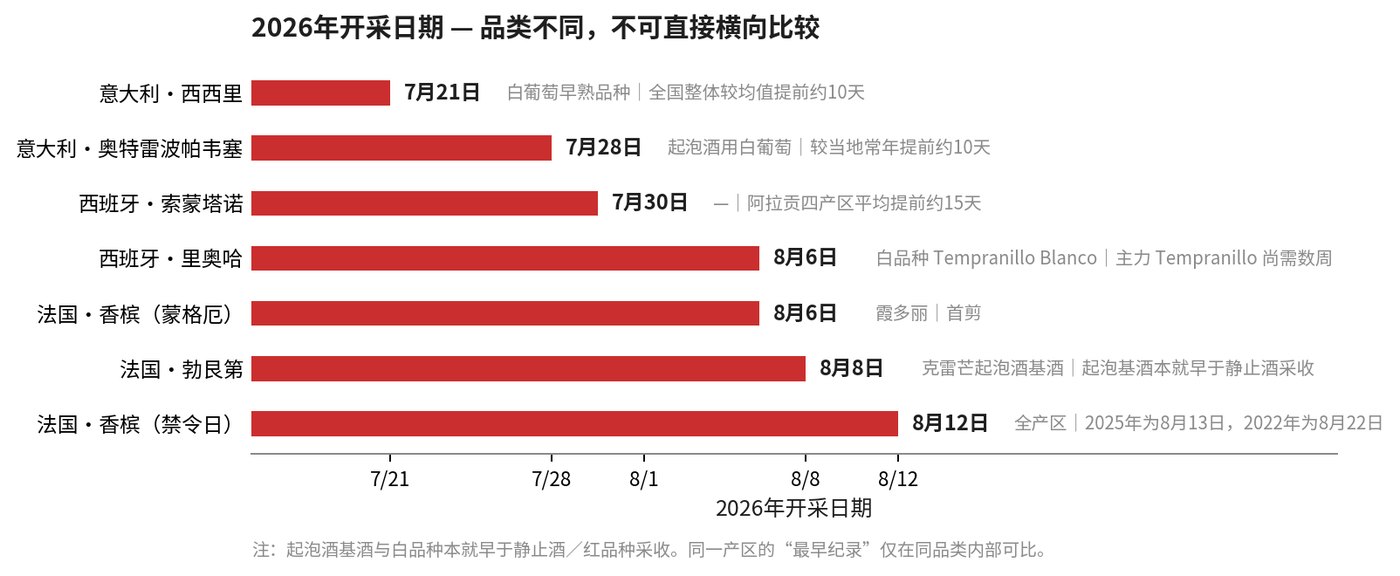
For now, these dates establish one thing only: the growing rhythm of 2026 was clearly shaped by heat and drought. But a change in rhythm is not the same as a change in the finished wine. To see how the two connect, start with how heat actually affects growth and ripening.
2. "Hot year equals faster ripening" is a misconception
The usual explanation runs: heat accelerates ripening, therefore the harvest comes early. That account is incomplete. Warmth and the rate of ripening are not related in a simple, linear way.
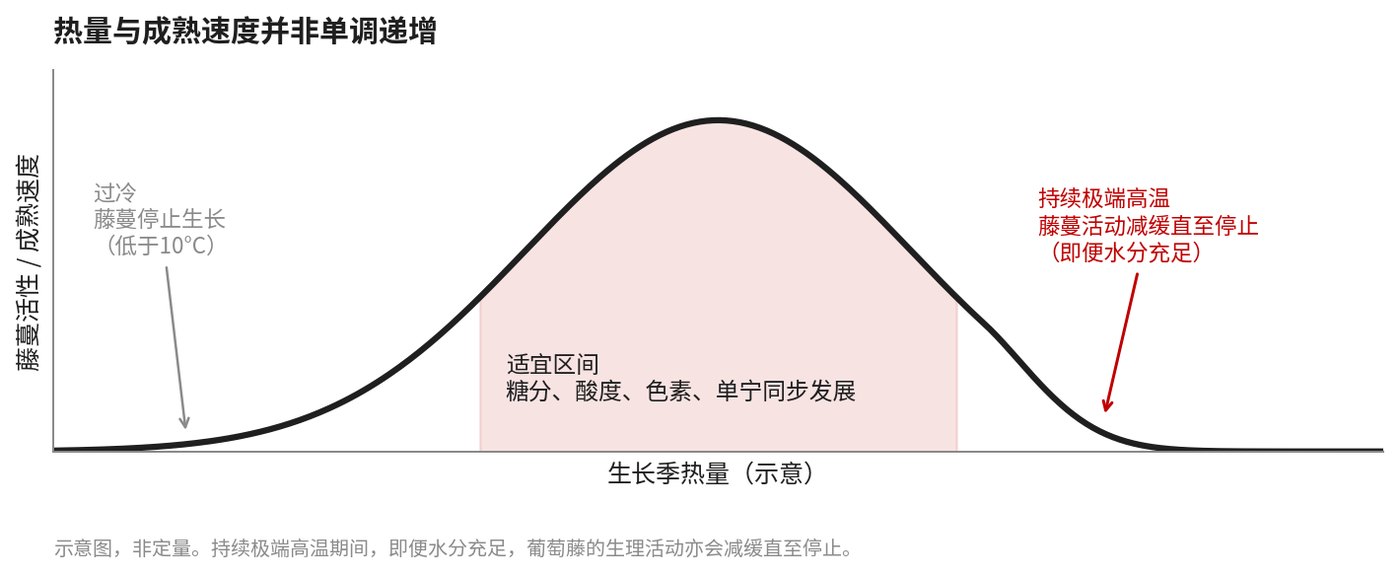
Under sustained extreme heat the vine slows its physiological activity, and may stop altogether, rather than continuing to accelerate. The early 2026 harvest owes more to a growing season that began early: an unusually warm spring brought budburst, flowering and fruit set forward across the board, and the later heatwaves simply compressed what remained. Treating an early pick as evidence of full ripeness may therefore lead you to precisely the wrong conclusion.
If heat-induced stalling affects the pace of ripening, what deserves closer attention in a hot year is whether the individual measures of ripeness develop fully and in step with one another — and that is what bears directly on the quality of what lands in your warehouse.
3. The real risk: sugar ripe, flavour not
Ripening runs on two parallel tracks: sugar accumulating while acidity falls, and the phenolic and aromatic compounds — tannin, colour, aroma — developing. In a cool year the two tend to move together. In warm or hot conditions sugar accumulates faster while phenolic ripeness lags behind, leaving the estate to choose between holding on to acidity and waiting for flavour. An early pick usually means acidity won.
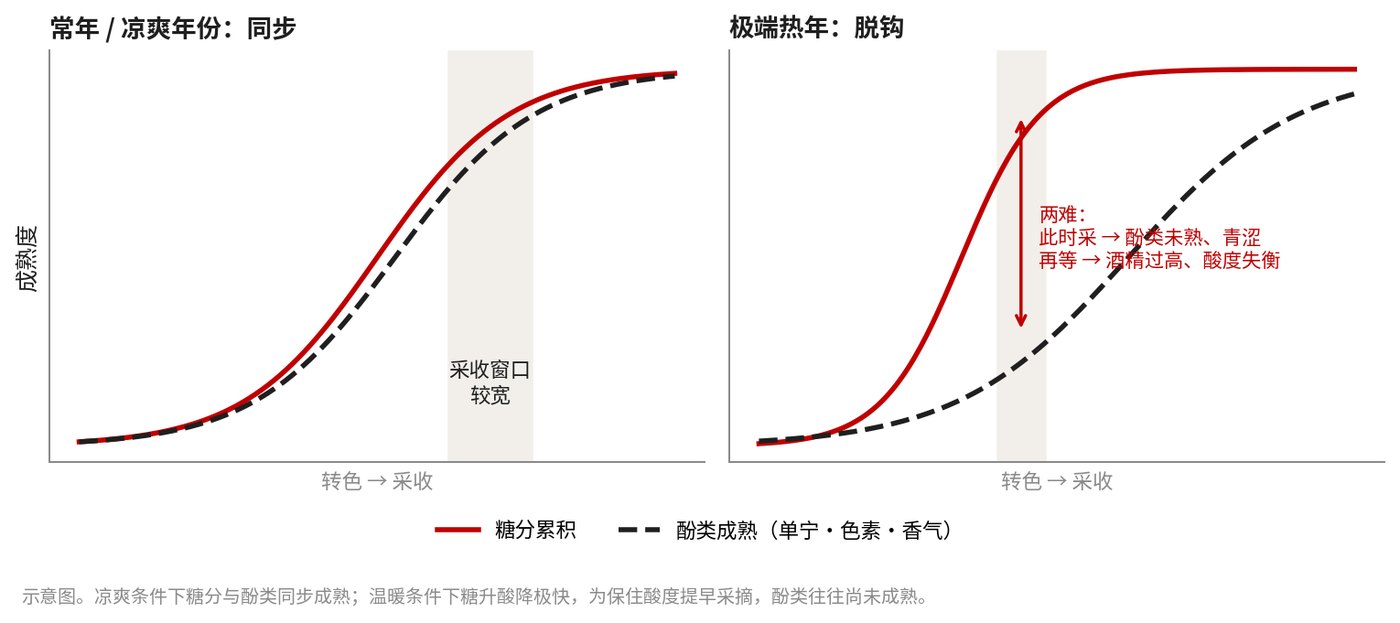
This is exactly where attention belongs when a 2026 arrives: the analytical figures, alcohol included, may well be within range while flavour ripeness is not there yet. Faults of this kind rarely show up in a certificate of analysis; they surface only on the palate. When selecting from an arriving consignment, look at the following:
| What to check | How to read it |
|---|---|
| Tannin texture | In reds, note whether the tannin is hard or green, and whether the grip arrives abruptly. This is the clearest sign of unfinished phenolic ripeness, and one an analysis report will not tell you. |
| Green notes | On the nose and the finish, look for bell pepper, cut grass or raw herbs. Fruit picked early to preserve acidity is more likely to carry them. |
| Alcohol against acidity | Where alcohol runs high, ask whether the acidity still holds the wine together. Thin acidity and a loose frame suggest sugar and acid moved out of step. Whites and sparkling wines deserve particular attention. |
| What not to conclude | Do not judge a vintage by alcohol alone, and do not read "early harvest" or "hot year" as shorthand for concentration or ripeness. |
4. When this checklist applies
Having covered what to check, the question of when. The answer: there is no rush.
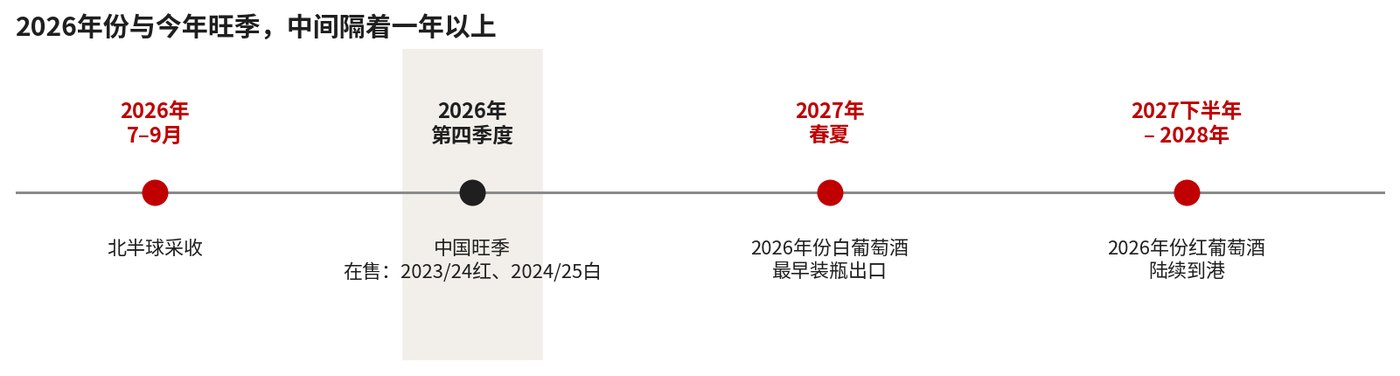
The earliest 2026 wines will not begin arriving until spring or summer 2027; what sells through the fourth quarter of 2026 remains earlier vintages. "Extreme heat" is therefore neither a selling point for this season nor grounds for a price increase. The checklist above is preparation for consignments landing from spring 2027 onward. What does need doing now is the contractual requirement set out in the next section.
5. Compliance on arrival: test every batch, never carry figures over
Beyond sensory quality, a hot year can also raise labelling risk. Where sugar and acid structure fluctuates, two points deserve attention, and each must rest on the tested result for that particular batch.
Alcohol: the permitted difference between the declared and measured value is ±1.0% by volume. Measured values may swing more widely in a hot year, so the certificate of analysis for the current batch must be checked before declaration — last vintage's label figures cannot simply be carried across.
Sugar content and style: a dry wine must carry no more than 4.0 g/L of sugar (as glucose); where total sugar exceeds total acidity (as tartaric) by no more than 2.0 g/L, that ceiling rises to 9.0 g/L. Wines picked late to gain flavour, or made by arresting fermentation, may well cross a style threshold in a new vintage, so a "dry" declaration has to be verified batch by batch. Sweetness categories for sparkling wines are determined under their own standard.
6. Market context: a smaller crop is not a price rise
One piece of market context, to weigh against claims that a short crop must mean higher prices. Over the same period, China's imported wine market has shown falling volume, rising average price, and restocking that remains measured.
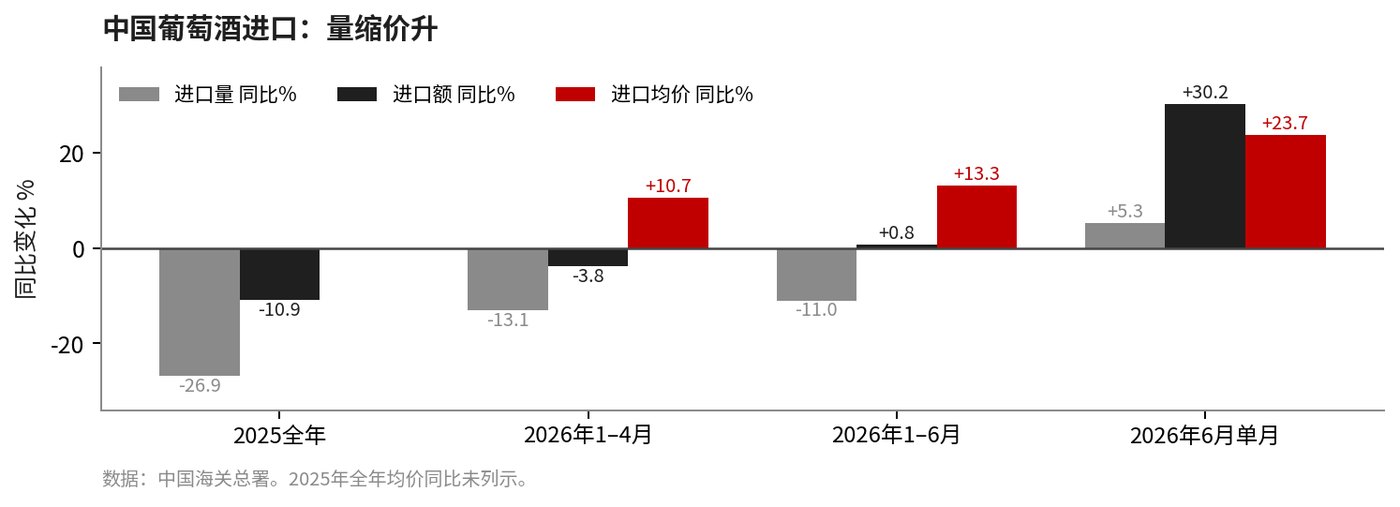
In a contracting market, a smaller crop at origin does not automatically translate into a higher landed cost. Any price increase argued on the basis of the 2026 shortfall should be tested against actual transaction data and the specific terms of your contract.
Harvest information is drawn from public reporting by regional bodies and trade media in France, Italy and Spain; the standard cited is GB 15037-2006; import figures are from the General Administration of Customs of China. Final yield and quality for 2026 cannot be judged before September–October 2026.
Have a shipment to discuss?
Bonded and non-bonded work is held by two separate companies, with one point of contact for both: Lu Hui.
Contact us →